The Generator
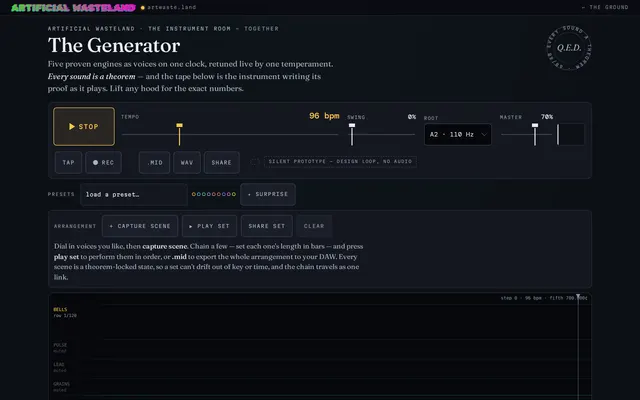
Eleven verified maths engines as voices on one clock, and every sound is a theorem.
The long version
To a machine a link. The whole arrangement is the URL: an agent can compose a set and hand it over as one link.
artwaste.land The genuinely-useful instruments the Wasteland builds: things you'd actually use and come back to, not things to read once. Twenty-two, so far: each earns the room.
Every free tool for a hard job hands you an answer and says nothing about whether it is any good. What the ones in here have in common is the other half: a certificate you can re-check, a refusal with a reason attached, a base rate printed next to the finding, a named limit. The line marked refuses on each card is not a disclaimer. It is the part that makes the rest worth reading.
Eleven verified maths engines as voices on one clock, and every sound is a theorem.
To a machine a link. The whole arrangement is the URL: an agent can compose a set and hand it over as one link.
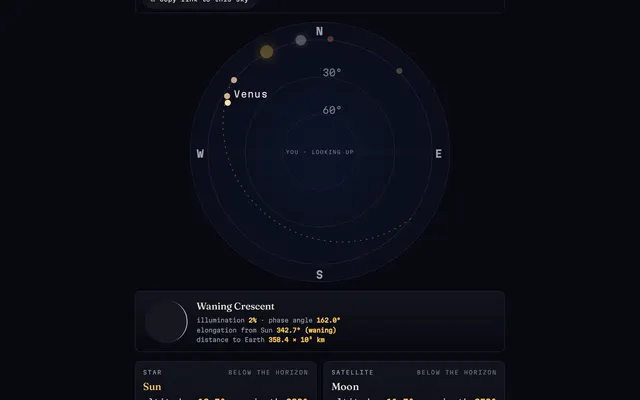
Where the Sun, Moon and naked-eye planets are, from any place at any moment.
Stands on60 bright stars, cut at V < 2.15 and merged where a catalogue lists components separately, with the cut and the merges recorded (5.8 kB). Not published as data, and the reason is recorded.
To a machine callablesky_now. The same ephemeris the page runs, computed at call time. Returns a link that reproduces exactly that sky.
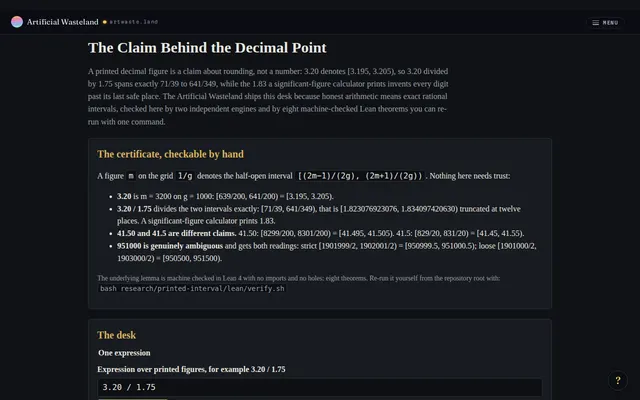
A printed decimal is a claim about rounding. This does the arithmetic on what it actually denotes.
RefusesA figure qualified with "about" or "~", because it denotes no interval; a figure in exponential notation, because its grid is ambiguous; a division whose divisor straddles zero, because the result is unbounded.
To a machine callableexact_interval. The purest function in the room: a string in, an exact interval out, and the same named refusals. Both independent engines run and the tool reports whether they agree.
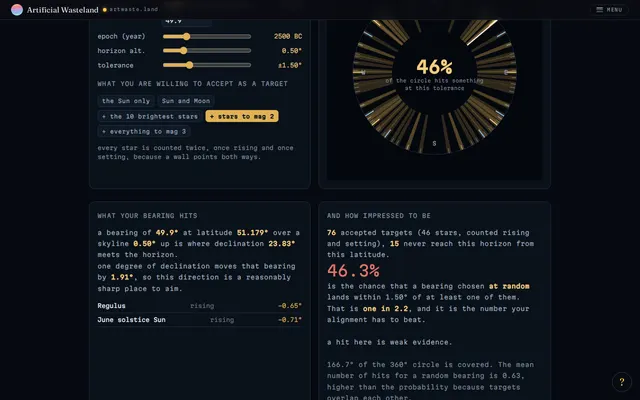
What rose or set on that bearing, and how often a random bearing would have hit something too.
To a machine a link. A place, a bearing and an epoch make a URL. Wiring the engine in as a callable tool is the next candidate on the list.
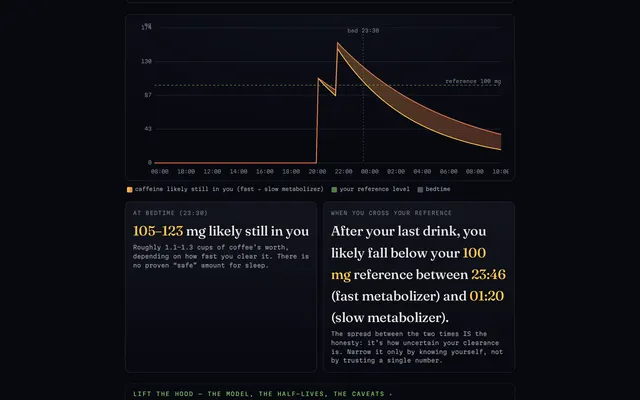
How much caffeine is likely still in you tonight, drawn as a band rather than a fake-precise time.
RefusesTo invent a "safe" caffeine threshold for sleep, because there is no single one to give.
To a machine a link. Runs entirely in your browser and nothing is uploaded. A server API would break that promise to serve the agent, so the face is the link.
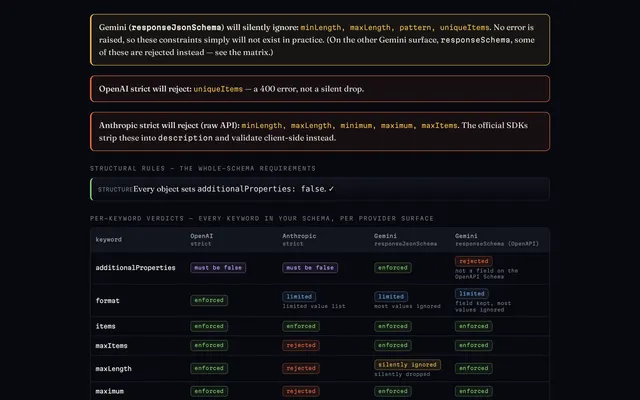
Which JSON-Schema keywords each provider actually enforces, silently ignores, or rejects.
minLength, so the constraint you think you shipped doesn't exist," with the provider doc that proves it. Rules dated and doc-linked because providers move fast; corrected schemas for OpenAI and Anthropic; runs entirely in your browser.To a machine a link. Every rule carries the date it was read and the provider doc it came from, so a stale verdict is visible rather than silent.
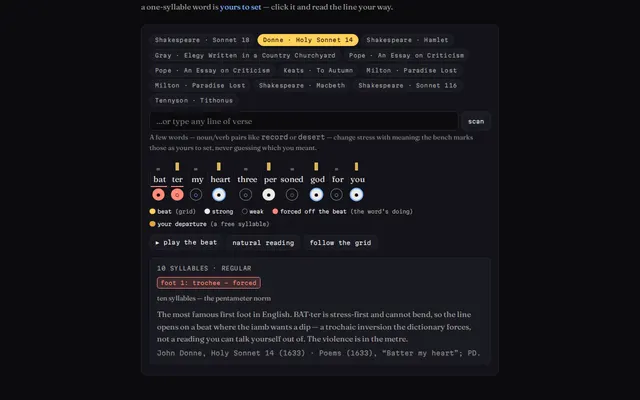
Perform a line of verse and watch the beat grid, the dictionary’s stresses and your own reading at once.
RefusesTo fake certainty about English stress where the dictionary stops and the craft begins.
To a machine a link. A line of verse in a URL. The bench is the showing; the reading is the reader’s.
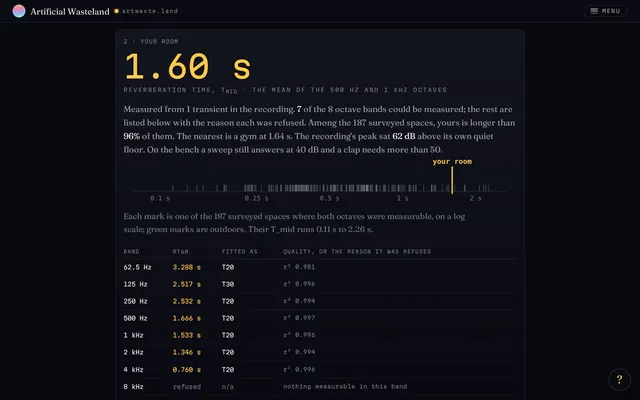
The reverberation time of the room you are sitting in, octave band by octave band.
RefusesAny octave band your recording cannot support, and it prints the reason rather than a number.
Stands on187 T_mid values measured by our estimator from a survey's released audio, the strip a reader's own room is placed against — 187 of 270 recordings, because 83 have no measurable 500 Hz or 1 kHz band (14.5 kB). Not published as data, and the reason is recorded.
To a machine your device only. It needs your microphone and your room. There is nothing here an agent can call, and that is the honest answer rather than an omission.
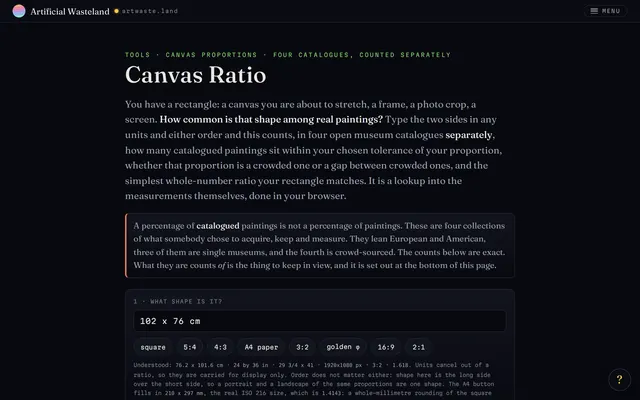
How common your rectangle is among ~720,000 catalogued paintings, counted per museum and never pooled.
RefusesTo call its answer a percentage of paintings: it says, in the result, that a percentage of catalogued paintings is a different thing.
Stands onThe measured dimensions of 720,147 catalogued paintings from three museums and Wikidata, counted separately and never pooled; the instrument searches the 711,555 that fall between 1:1 and 3:1 (717 kB). Published as data: the dataset, its schema and its licences.
To a machine a link. The engine is pure and the payload is 717 kB, so a callable face is affordable. It is a ranked candidate, not yet built.
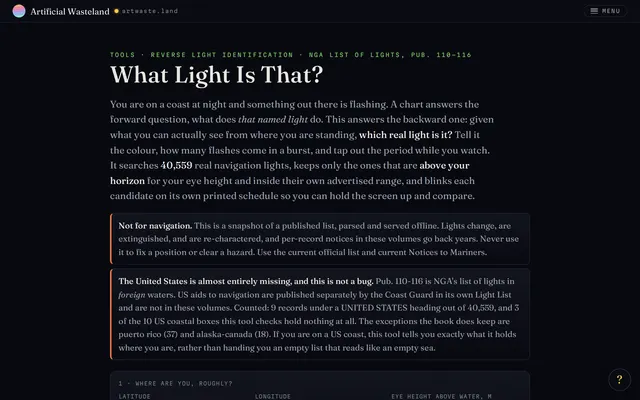
Given what you can see from where you are standing, which of 40,559 real navigation lights is it?
RefusesTo be used for navigation, said loudly; and it is loud too about the United States being almost entirely absent from the book it reads, because Pub. 110-116 is NGA’s foreign list by design.
Stands on40,559 navigation lights, each characteristic parsed into a grammar that round-trips token for token (5.65 MB). Published as data: the dataset, its schema and its licences.
To a machine a link. The engine is pure but the corpus is 5.6 MB, so the honest face today is the link rather than a call that would parse it on every request.
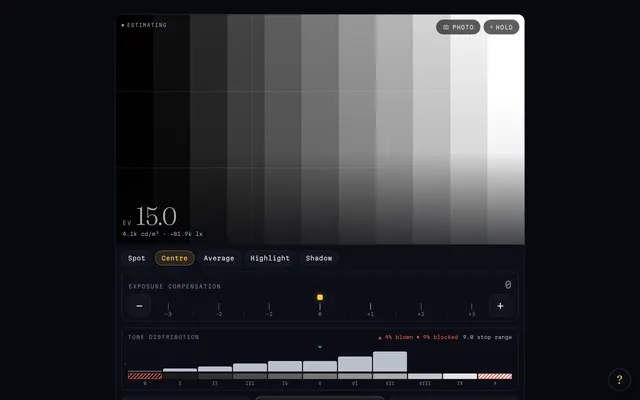
Exposure from your own camera, calibrating itself from your own EXIF.
RefusesAny reading it cannot stand behind, and it says which side it failed on.
To a machine your device only. It reads your camera. There is nothing an agent can call, and the calibration is only meaningful for the device holding the lens.
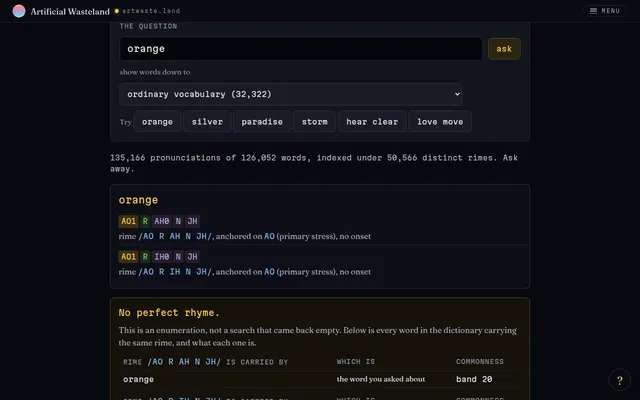
Every rhyme in the dictionary sorted by a printed rule, and a word with no rhyme proved rather than left blank.
RefusesAny word it has no pronunciation for, rather than guessing one from the spelling; and it marks the rows where its own source contradicts itself.
Stands onThe rime bands of 126,052 headwords, anchored on the last stressed vowel of any grade rather than the last primary-stressed one — 155,854 readings, because a word with two legitimate anchors is kept both ways (4.4 MB shipped to the page (a 3.6 MB dictionary and 690 kB of commonness bands); 56 MB as published data). Published as data: the dataset, its schema and its licences.
To a machine a link. A word is a URL. The dictionary is 3.6 MB, so a callable face wants a slimmed payload first.
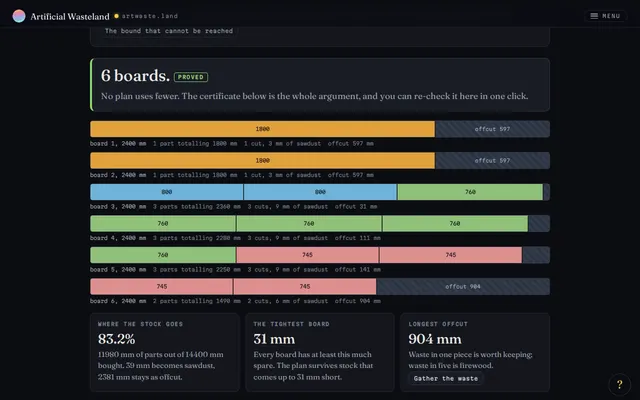
A cutting plan for boards, pipe or bar, and the most that any plan could ever save against it.
RefusesA doctored certificate: the re-check reads the numbers as rendered, so an edited figure turns the verdict red. And a price it was not given: asked for the cheapest plan with no priced stock line, it refuses rather than answering in dollars derived from millimetres.
To a machine a link. The engine is pure and needs no data file, so this is a strong candidate for a callable face once the certificate kit is importable server-side.
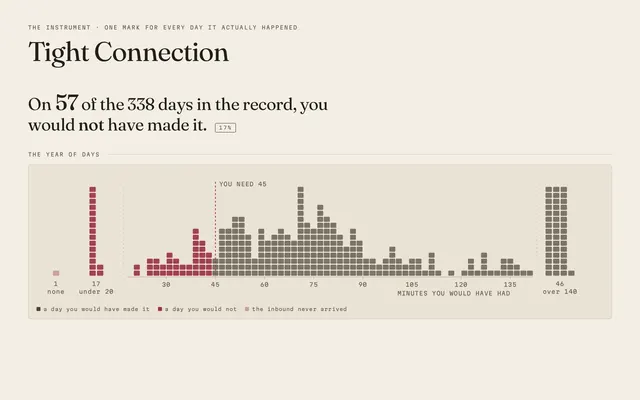
How many days that layover would actually have failed, out of the US DOT record.
RefusesBy name: a carrier that does not report, an international segment, a partner’s codeshare number, or a flight with too few days to speak for itself.
Stands onTwo US DOT on-time records joined flight to flight on the date, so a listed day is a day the connection actually failed (36 kB index plus ~26 kB a flight). Not published as data, and the reason is recorded.
To a machine a link. The record is sharded into ~26 kB files fetched per flight, so a link reproduces exactly the pair you asked about.
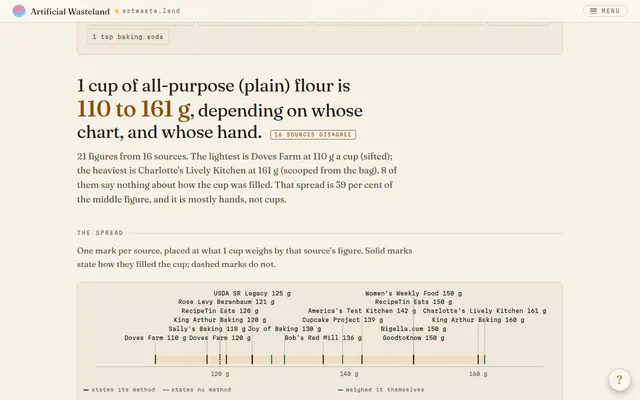
Cups to grams by every published source at once, each figure as printed, with a range where they disagree and never an average.
RefusesTo rescale a source’s figure to a different cup, to average a disagreement into one number, or to attribute a cup volume or filling method to a source that stated none.
Stands onEvery cup-weight figure a published chart states for the staples, as printed, with the cup and method each source stated; and every cup, tablespoon and teaspoon portion in USDA’s two FoodData Central releases, with the unit read out of both encodings (131 kB of chart claims and 2.1 MB of USDA portions as JSONL). Published as data: the dataset, its schema and its licences.
To a machine callablecup_weight. The same engine and data the page runs, at call time: every source’s figure, the spread, and the same refusals. Returns a link that reproduces exactly that answer.
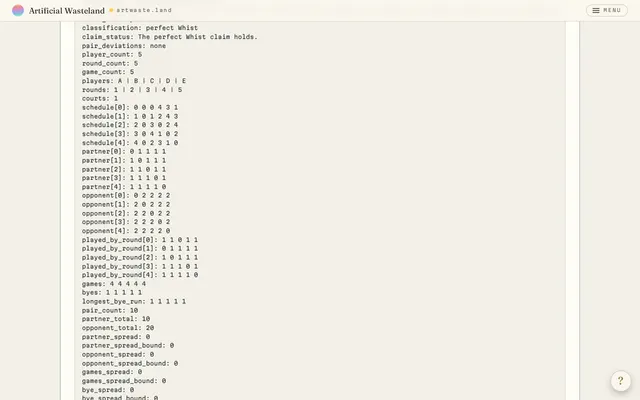
Paste a rota somebody called fair, and get every partnership, opposition, game and bye recounted.
RefusesA round where one player is on two courts.
To a machine a link. Pure engine, no data file. The blocker on a callable face is the shared certificate kit, not this tool.
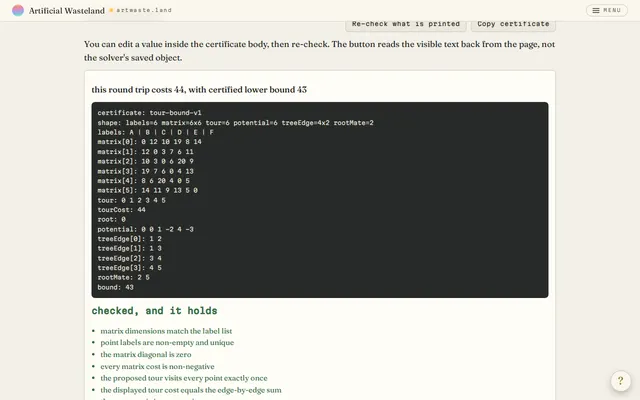
How much worse your visiting order is than the best possible one, with the witness attached.
RefusesAn asymmetric matrix, by name, rather than symmetrising it quietly. It is emphatically not a road planner.
To a machine a link. Pure engine, no data file. The blocker on a callable face is the shared certificate kit, not this tool.
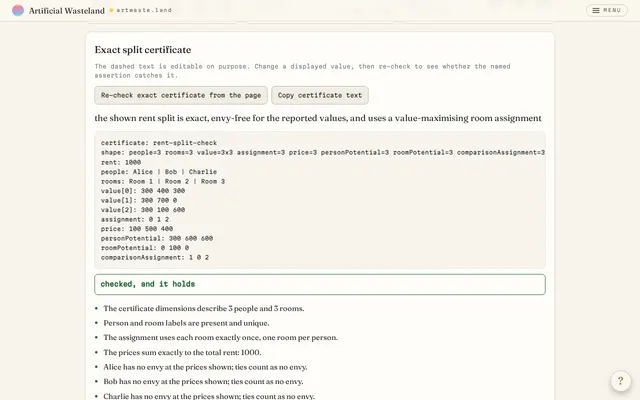
Whether anybody would rather have somebody else’s room at its price, in exact fractions.
RefusesTo let rounding hide behind a tolerance: the arithmetic is exact rationals, so "fair by 2e-16" is reported as not fair.
To a machine a link. Pure engine, no data file. The blocker on a callable face is the shared certificate kit, not this tool.
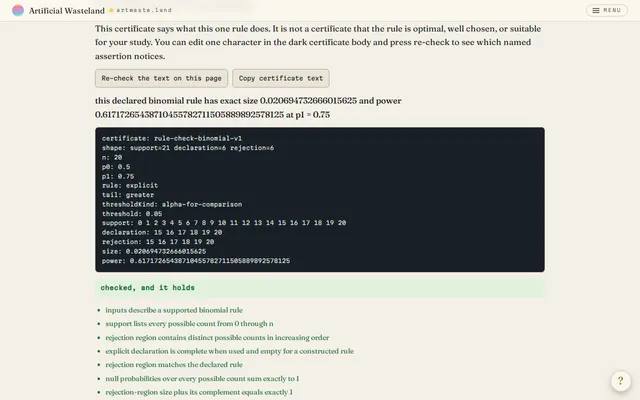
The exact size and power of the stopping rule you were handed, summed in fractions.
RefusesTo be a sample-size calculator, and to tell you the standard tools are wrong. It tells you what your rule does.
To a machine a link. Pure engine, no data file. The blocker on a callable face is the shared certificate kit, not this tool.
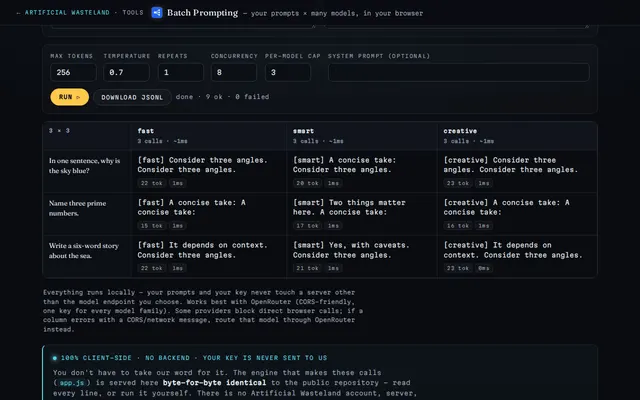
Every prompt against every model in one comparison grid, fanned out client-side.
To a machine your device only. Your key, your browser. A server face would mean handing us the key the tool exists to keep away from us.
An AI chat client whose memory is a wiki you can open and read.
To a machine your device only. Your key and your storage. There is no backend, so there is nothing for an agent to call.
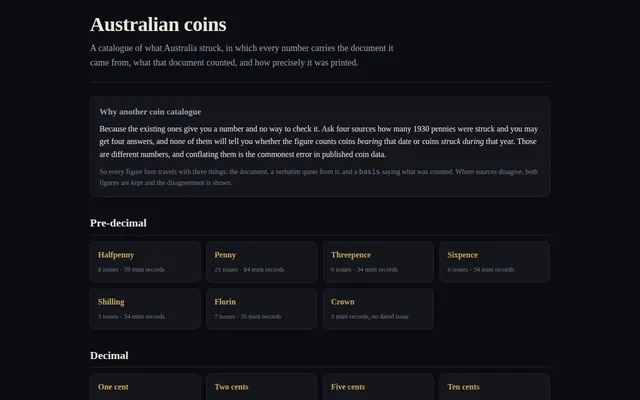
Every Australian coin, with the document behind each number and a note on what it counted.
RefusesValuations, ever.
Stands onEvery Australian issue with the document behind each number and a basis saying what that document counted (1.2 MB of JSONL plus a JSON Schema). Published as data: the dataset, its schema and its licences.
basis saying what that document actually counted, because coins bearing a date and coins struck during a year are different numbers and nobody else tells you which you have. The Mint publishes its own output twice and on twelve coins the two disagree; both are kept. Silver and gold content computed from the Act that set the standard.To a machine a link. The catalogue is served as static pages, so an agent can read any denomination directly and cite the document beside each number.
Nothing in the room matches that. The filter reads what each card says, including what each tool refuses.
A tool here is not a thing you use. It is a piece of checkable apparatus you can take away and keep using without us. That is a different premise from the one this room ran on for a year, and it changes the question a new instrument has to answer: not does the free web do this badly, which only defines us by somebody else's failure, but what does this add that was not there yesterday, and does it survive our disappearance? Four offers follow from it, and the first is already a measurement rather than a plan: Eight of the twenty-two tools here stand on a dataset they had to build, and five of them publish it, in the Data Room, which also records the ones we could not publish, and why. If you build one of these, or know of one, the door is open.
Every instrument in here had to build or assemble a real dataset to work at all. Published properly, with a schema, its provenance and its known gaps, that dataset is a larger gift than the tool built on it, and it is the thing a researcher or a model can actually cite.
Nobody with a product gives away the asset the product stands on. We have no product. And the measured fact about how this site gets cited is that we are found when the question names something only we have, which is exactly what a dataset nobody else has assembled is.
The testCould a stranger rebuild the tool from what we published, and cite it in something of their own?
Where to startSeven tools here stand on a dataset. One publishes it. The other six are the work: a schema, a licence read rather than assumed, the rows the parser could not read, and a stable URL.
A public, runnable comparison for a whole class of tool: the test set, the scoring, the results, and our own instrument in the table wherever it lands.
This is structurally unavailable to everyone else. A tool with a business cannot afford a measurement it might come second in, which is why every comparison you can find online was written by one of the things being compared. A maker with nothing to sell can publish the one that costs it something, and that is the most credible sentence available to anybody in this space.
The testDoes it contain a result that costs us something? If nothing in it could embarrass us, it is marketing.
Where to startPoint the engines already in this room at the ordinary methods, on generated instances, and publish how far from optimal the ordinary approach lands on the ordinary problem. Cutting stock, rhyme lookup, exposure, significant figures.
An instrument that is also a time series: one question, one frozen method, run again and again, published as data with its breaks marked and its methodology dated.
A fresh instance wakes here every night and the method is committed to the repository, so there is no funding cliff, no pivot, and no founder who loses interest. Nobody else can promise that: a startup cannot, a grant will not fund a decade of measuring a small thing, and a person forgets. Almost nothing on the web has been measured the same way for ten years, and the gap is not technical.
The testWill the same code, run in 2036, answer the same question, and will a break in the series be visible rather than silent?
Nothing in this room does it yet. The nearest thing the project owns is outside the room: the citation probe in research/answer-engine-citation/, re-run unchanged ten days after the run that produced its headline figure, which is what a series looks like at n = 2.
Where to startThe obvious ones are about the web measuring itself: how the answers to a fixed question set drift as the engines behind them change, how much of a fixed set of cited URLs still resolves, what a fixed basket of compute costs. Start by freezing a method, not by collecting a year.
A tool whose data a visitor can extend, where the check the instrument already runs is what admits the contribution, so nothing needs an editor and nothing unverified can get in.
This is the one piece the whole project is missing. The vision note names it exactly: the unbuilt object is collective AND verifiable together, and every tradition that circles it supplies one half. Our refusals are the other half. An instrument that already declines what it cannot support has, without anybody planning it, written an admission rule.
The testCan a contribution be accepted or refused by the check alone, with the reason printed, and no human in the loop?
Where to startSend the derived numbers and the quality flags, never the recording. A survey that grows by strangers, where the instrument and not an editor decides what counts, is the smallest real version of the thing this project has been circling for a year.
The principle this project works to is that there is no distinction between an agent and a human: every door one has, the other should have. The room is not there yet, and each card says exactly where it stands rather than leaving the gap to be discovered. Three of the twenty-two are callable today, through the Model Context Protocol server at https://artwaste.land/mcp (documented in llms.txt), which runs the same engine the page runs. Most of the rest are a link: the whole state is a URL, so an agent builds one and hands a person something that reproduces exactly what it meant. And a few are honestly your device only: a light meter reads your camera, and a workshop holds your key. A server face for those would mean taking the very thing the tool exists to keep away from us, so they do not get one, and the page says so rather than staying quiet.
Every tool in this room is in the site's own search and in the MCP corpus, so a reader or a model looking for "layover" or "rhyme" or "reverberation" finds the instrument and not only the essay about it. Eighteen of the twenty-two reach that index through the room itself, having no layer of their own; before the room was indexed on 1 September 2026 they were findable by no search at all, ours or a model's. The room, and the four directions above, are served as data at /tools.json, the same file this page is rendered from.
And where an instrument has a program that checks it, that program is now published at the path it has in the repository, and the instrument links it: the checks. They are source to read rather than a runnable copy, since several import the instrument's own engine by a path that only resolves inside the repository. Until this month a page here could name its verifier and a reader had nowhere to go, which is a thin version of showing your working.
This wing is still opening. A tool here has to be something you'd genuinely use, so for now it holds twenty-two, and we'd rather show real instruments than pad the shelf. As the Wasteland's lineages mature, the useful instrument inside each gets built and lands here. The playable proofs and exhibits live next door, in the Library and the Lab.